 Kudosky
Psychological Safety at Work: How to Build a Culture Where People Speak Up
April 26, 2026
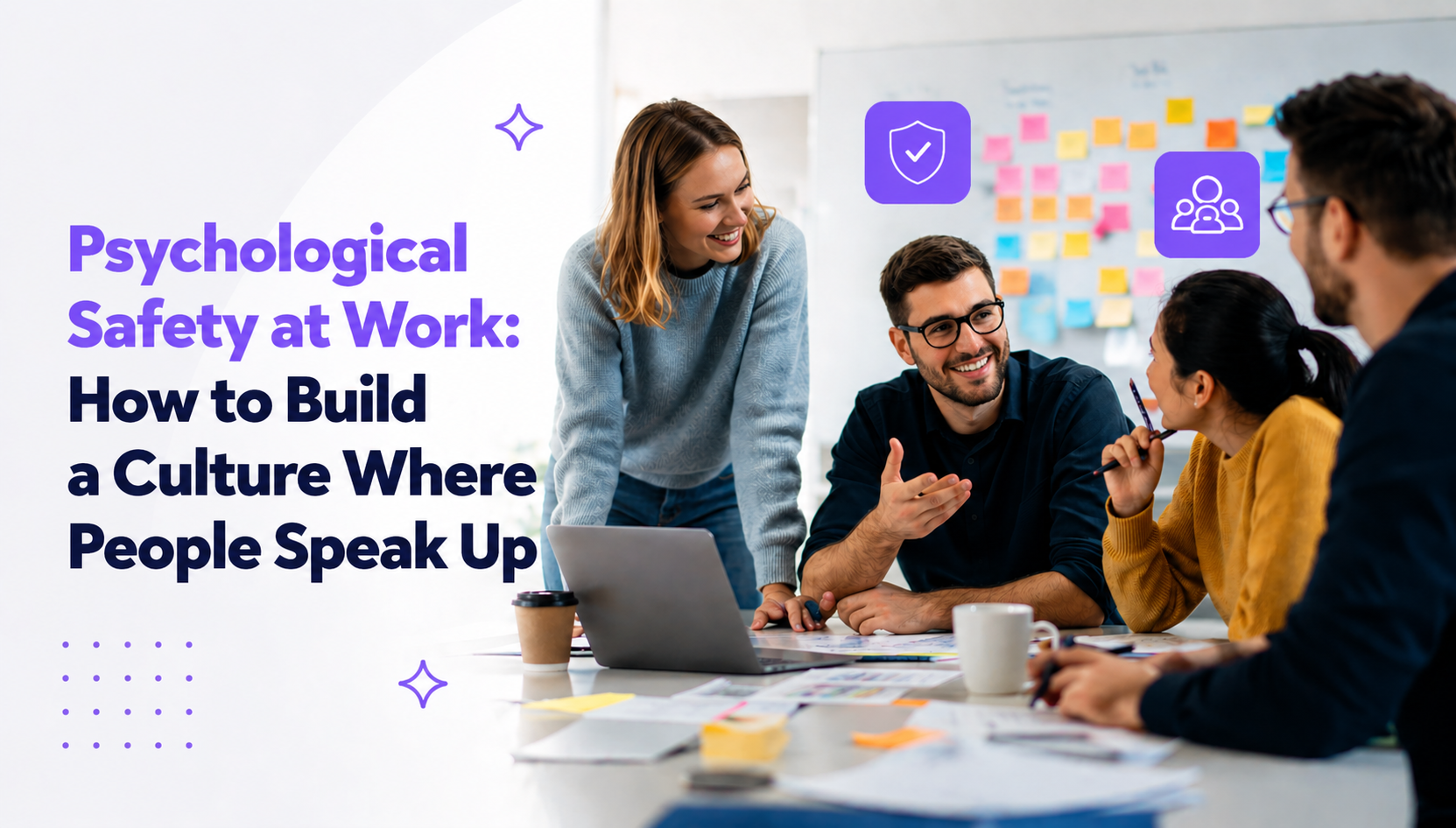
Psychological safety is the single most important predictor of high-performing teams — more than talent, experience, or access to resources. That finding comes from Google's landmark Project Aristotle study, which analyzed hundreds of internal teams over two years to discover what separates the best from the rest. The answer was not who was on the team, but how team members interacted. When people feel safe to speak up, ask questions, raise concerns, and admit mistakes without fear of ridicule or punishment, they perform at an entirely different level.
In this article, we explore what psychological safety actually is, why it matters more urgently than ever in today's workplace, and the practical steps leaders can take to start building it right now.
What Is Psychological Safety?
The concept was defined by Harvard Business School professor Amy Edmondson, who describes it as a belief that one will not be punished or humiliated for speaking up with ideas, questions, concerns, or mistakes. It is important to understand what it is not: psychological safety does not mean avoiding conflict, softening every piece of feedback, or shielding people from accountability. Teams with high psychological safety often have more productive disagreements — because people feel confident enough to engage honestly with difficult topics. Think of it as the invisible infrastructure that makes genuine collaboration possible.
Why It Matters More Than Ever
Several forces have converged to make psychological safety a genuine business imperative:
- Remote and hybrid work has eliminated the informal trust-building moments — hallway conversations, shared lunches, and spontaneous check-ins — that once made it natural to flag concerns in real time.
- The pace of change means organizations urgently need employees to surface problems and ideas quickly, not hold on to concerns until the next annual review.
- AI and automation anxiety is making people reluctant to admit uncertainty or knowledge gaps, for fear of appearing replaceable in an automated future.
- The talent retention crisis means that employees who do not feel psychologically safe do not complain — they simply leave, rarely explaining why.
Warning Signs Your Team Lacks Psychological Safety
- Meetings dominated by a few voices while many others stay silent
- Feedback and ideas flow only downward — from leadership to staff, never upward
- Mistakes are minimized or hidden rather than discussed and learned from
- Survey participation is low or responses are suspiciously uniform and positive
- High employee turnover concentrated under specific managers or in specific teams
Five Practices That Actually Build Psychological Safety
1. Model vulnerability from the top. The most powerful signal a leader can send is their own willingness to be uncertain, wrong, or unfinished. When a manager says "I made a mistake here" or "I don't know — what does everyone think?", they give everyone else permission to do the same. This is not weakness; it is one of the highest-leverage behaviors available to any leader.
2. Create regular, low-stakes feedback loops. Waiting for annual surveys to understand how your team really feels is like checking your health once a year and ignoring symptoms in between. Tools like Kudosky enable continuous micro-feedback — brief, frequent pulses that normalize honest input. When feedback becomes routine rather than an event, it loses its threatening quality.
3. Respond to bad news without blame. How you react the first time something goes wrong is the most powerful lesson you will ever teach your team. Responding with curiosity instead of blame — "What happened? What can we learn?" rather than "Who did this?" — signals that it is safe to surface problems early, before they escalate.
4. Always close the feedback loop. Nothing erodes psychological safety faster than feedback that disappears. When people share concerns and hear nothing back, they learn speaking up is not worth the risk. Acknowledge what you heard, explain what you are doing about it or why you are not, and follow through on every commitment.
5. Explicitly celebrate courageous acts. When someone raises a difficult issue, challenges a popular assumption, or publicly acknowledges a mistake, name it as a positive contribution. Saying "I appreciate you flagging that — it takes courage" sends a clear signal to everyone: this is the behavior we value here.
How Technology Can Help
HR technology — when designed thoughtfully — can meaningfully accelerate this journey. Platforms like Kudosky offer anonymous micro-feedback, real-time pulse surveys, and AI-powered insights through KAIA, our intelligent HR copilot. KAIA does not simply collect data — it identifies patterns, surfaces emerging concerns, and helps leaders understand where attention is most needed. The key principle: technology creates the conditions for psychological safety, but people make it real.
How to Measure Your Progress
You cannot manage what you cannot measure. Key indicators to track over time include:
- Participation rates in feedback tools — a low response rate is itself a warning signal
- eNPS scores and trends, broken down by team and manager over time
- Qualitative themes in open-text responses — are people raising real concerns or only safe, positive observations?
- Manager-specific scores in 360-degree feedback processes
- Retention rates broken down by team and reporting manager
Start Building a Safer Culture Today
Psychological safety is not built overnight — but it is built, one conversation and one courageous act at a time. Organizations that invest in it consistently outperform those that do not, across retention, innovation, and resilience. You do not need a large budget. You need intention, consistency, and the right tools.
Ready to create a workplace where people genuinely speak up? Start your free Kudosky account at https://kudosky.app/auth/signup and see what continuous, meaningful feedback can do for your culture. Or book a personalized demo at https://calendly.com/hello-kudosky/kudosky — and see how leading companies are building psychologically safe, high-performing teams at scale.
Make the good work visible.
Recognition that fits the day your team already has: colleague to colleague, in Slack and Teams.