 Kudosky
Why Annual Employee Surveys Are Killing Your Company Culture (And What to Do Instead)
April 10, 2026
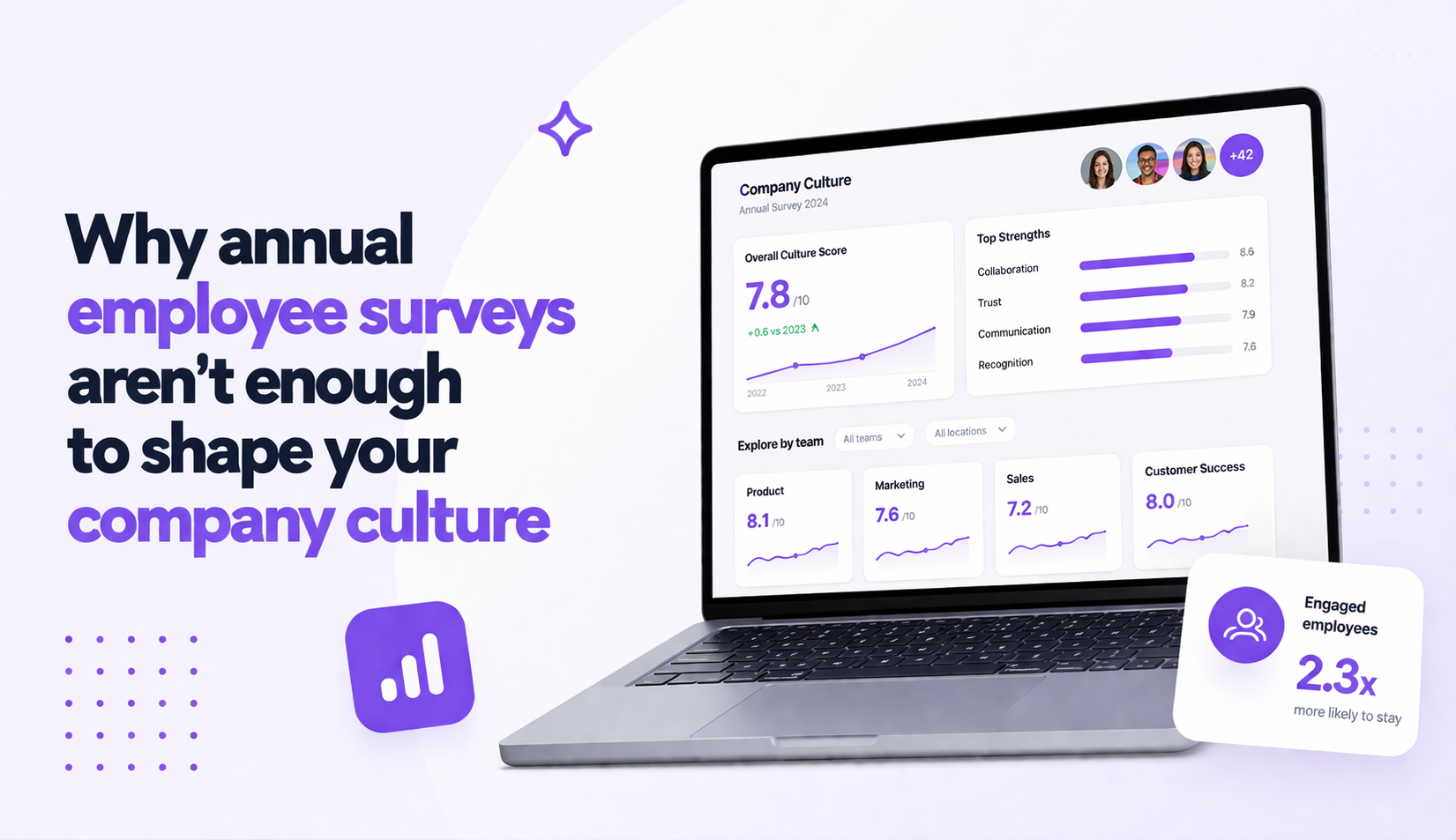
Every January, HR teams across the world send out the same email. "It's time for our annual employee engagement survey!" Employees dutifully click through 40 questions, give rushed answers, and promptly forget about it. Six months later, leadership shares a slide deck with last year's results. By then, half the team has mentally moved on — some have already physically moved on.
Sound familiar? You're not alone. And the problem isn't the people — it's the model.
The Illusion of the Annual Survey
Annual surveys were designed for a world that no longer exists. In the era of quarterly OKRs, Slack pings, and remote-first teams, waiting 12 months to understand how your employees feel is the equivalent of checking your car's oil once a year — and hoping nothing breaks in between.
Here's what the data actually tells us:
- Response rates for annual surveys average just 30–40%. That means you're making culture decisions based on less than half your workforce.
- The feedback is stale by the time it's acted on. A team that was frustrated in November won't benefit from changes implemented in April.
- Survey fatigue is real. The longer and rarer the survey, the less honest the answers.
You're not measuring engagement. You're measuring a memory of engagement — filtered through exhaustion and resignation.
What Happens in the Gaps
Annual surveys completely miss the day-to-day emotional reality of your workplace. Monday felt great because the project kickoff went well. Wednesday was rough after a tense all-hands. Friday everyone was drained from a deadline crunch. These micro-moments — the ones that actually shape whether someone stays or leaves — disappear between survey cycles.
Research from Gallup shows that employees who feel their voice matters are 4.6x more likely to feel empowered to perform their best work. But that empowerment only comes from feeling heard continuously — not once a year.
The Micro-Feedback Revolution
The solution isn't a better survey. It's a completely different approach: micro-feedback. Small, consistent signals are more accurate and more actionable than large, infrequent ones. Instead of asking 40 questions once a year, you ask 1–3 questions daily or weekly, in the flow of work. Done right, this gives you:
- Real-time pulse data. You see how engagement shifts after a reorg or a difficult quarter — while you can still do something about it.
- Higher participation. A 10-second daily check-in gets dramatically higher response rates than a 20-minute annual survey.
- Honest answers. Short, low-stakes questions reduce the social pressure to give "correct" answers.
- Early warning signals. A dip in team mood for three weeks running isn't random — it's a pattern. Micro-feedback surfaces these before they become resignations.
Recognition as Feedback
One of the most underrated forms of feedback is peer recognition. When a colleague sends a kudo — a simple acknowledgment of your contribution — it validates the recipient and generates a data signal for the organization. Patterns in recognition reveal what your team actually values. When recognition drops in a particular department, that's a warning sign. The best engagement strategies combine micro-feedback with peer recognition — you get both the emotional signal and the relational context.
The Role of AI in Making Sense of It All
Daily micro-feedback generates a lot of data. Without the right tools, that data becomes noise. AI-powered HR insights change the game — instead of a human analyst spending weeks processing survey results, an AI engine surfaces patterns in real time, identifying which teams are at risk, which managers are thriving, and what specific issues are driving disengagement. Imagine knowing, not in April after an annual review, but this Tuesday morning, that Team B's morale has dropped 15% since a new process was introduced two weeks ago. That's an intervention you can actually make.
From eNPS to Real-Time Engagement
Many companies already use eNPS (Employee Net Promoter Score) as a shorthand for engagement health. But eNPS measured once a quarter is still a lagging indicator. The real power comes when you convert daily mood ratings into a continuous eNPS signal — you start to see not just whether employees would recommend working at your company, but when and why that sentiment rises and falls. That nuance is invisible in a quarterly snapshot.
Making the Switch
Transitioning from annual surveys to continuous micro-feedback doesn't mean abandoning structured assessment. Deep-dive surveys still have a place for specific topics like onboarding experience or manager effectiveness. The shift is about moving the default. Here's a practical starting point:
- Start with a daily mood check-in — one question, takes 5 seconds. Ask how people feel today on a simple scale.
- Add weekly micro-surveys — 2–3 rotating questions on workload, collaboration, and recognition.
- Layer in peer recognition — make it easy and habitual to acknowledge colleagues.
- Use AI to connect the dots — identify trends before they become problems.
- Close the loop visibly — let employees see what changed because of their feedback. Nothing kills feedback culture faster than silence.
The Bottom Line
Annual surveys don't fail because HR teams don't care. They fail because they were designed for a different era — one where change was slower, teams were more stable, and six-month turnaround times were acceptable. Today's workplace moves faster. The tools to understand employee experiences should match that pace.
The companies that will win the talent war in the next decade aren't the ones with the best annual survey scores. They're the ones where employees feel heard every single day — and where leadership acts on that signal fast enough to matter.
Make the good work visible.
Recognition that fits the day your team already has: colleague to colleague, in Slack and Teams.